
Agrivoltaics is the co-location of solar photovoltaic installations and active agricultural production—specifically rotational livestock grazing, pollinator forage linked to a working apiary, or shade-tolerant crop harvesting—on the same parcel of land throughout the operating life of the array. In Western North Carolina, where steep coves and ridgelines severely restrict arable acreage, energy developers and growers often compete for the exact same ground. Many working farms in Buncombe County span just 10 to 50 acres, and typically only a small fraction of each parcel consists of the gently sloped bottomland suitable for both vegetable cultivation and conventional ground-mount solar racking.
In this Article
- Defining Dual-Use Solar and Agricultural Production in Mountain Landscapes
- Comparing Solar Grazing and Shade-Tolerant Crop Configurations
- Soil Compaction, Topsoil Stripping, and Stormwater Safeguards on Sloped Land
- Structuring Farmer Access, Liability, and Multi-Year Land Tenure
- How to Submit Public Comment on Buncombe County Solar Permitting Rules
Defining Dual-Use Solar and Agricultural Production in Mountain Landscapes
When a solar facility replaces an active hayfield or vegetable block with turf grass and a mowing contract, the regional food system loses productive capacity. Ground-mount solar projects are commonly engineered for a 25-to-35-year operating life. That span represents a full generation of farm tenure. To protect regional food security while advancing renewable energy goals, land-use definitions must require continuous agricultural output across those three decades rather than accepting a passive cover crop at initial permit approval.
Working coalitions across the region, including the Asheville Buncombe Food Policy Council (ABFPC), evaluate solar siting through this lens of long-term farm viability. When local ordinances define dual-use strictly, energy infrastructure can stabilize farm household income without removing prime soils from the local supply chain. The USDA National Agricultural Library agrivoltaics resource guide documents how co-located systems function nationwide, but mountain topography demands localized engineering standards.
In Buncombe County, cool-season pasture experiences its primary growth flushes from roughly March through June and again from September through November. A genuine agrivoltaic site plan schedules animal movement and forage management around these biological windows rather than treating vegetation as a summer fire hazard to be mechanically bush-hogged on a fixed calendar. By anchoring permit definitions to measurable agricultural yield—whether measured in grazed forage days, honey production, or harvested specialty crops—county policy can prevent prime farmland conversion while supporting clean power generation.
Comparing Solar Grazing and Shade-Tolerant Crop Configurations
Selecting an array geometry in Western North Carolina starts with three field questions: what animal or implement must pass beneath the panels, how much vertical and horizontal clearance does that operation require, and who in the local agricultural economy already owns the equipment and livestock to execute the plan? Because regional graziers already manage commercial flocks and standard solar racking requires minimal modification to accommodate small ruminants, rotational sheep grazing represents the most immediate pathway for local dual-use arrays.
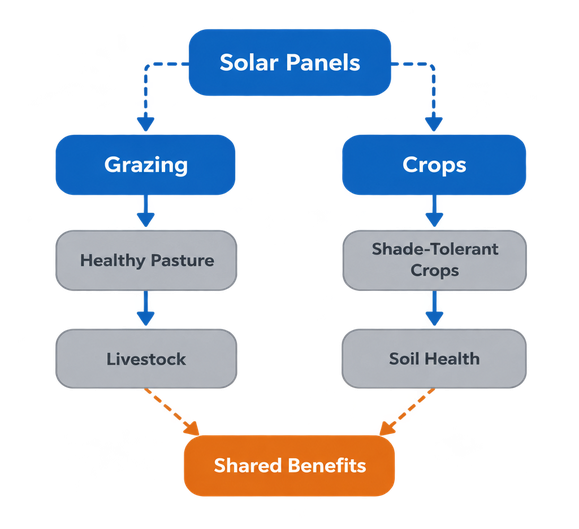
Elevated arrays built for horticultural production open a second pathway for high-value specialty crops, though they require steeper capital investment. Raising the steel superstructure to clear compact tractors or walk-behind tillers demands heavier pilings and bracing against wind uplift. For heavy row-crop machinery or beef cattle, the required structural reinforcement and racking clearances drive installation capital costs significantly higher, making sheep grazing and hand-tended specialty crops the most practical starting points on mountain parcels.
Racking Clearance and Row Spacing Benchmarks
- Rotational Sheep Grazing Arrays: Commonly specified with the lowest panel edge positioned 24 to 36 inches above grade. Electrical wiring must be routed inside rigid conduit or secured well above animal reach so sheep cannot rub against or chew through harnessing.
- Stocking and Rotation Intervals: Grazing plans under panels typically run at 2 to 4 ewes per fenced acre during active growth windows. Graziers move flocks between paddocks every 3 to 7 days based on forage height, maintaining rest periods of 21 to 40 days per paddock to prevent overgrazing and parasite buildup.
- Elevated Horticultural Arrays: Typically raised to provide 7 to 10 feet of vertical clearance beneath the lowest structural beam. Row centers are spaced 15 to 25 feet apart so operators can maneuver compact tractors, towed sprayers, or walk-behind beds shapers without risking panel strikes.
Both configurations alter the microclimate beneath the drip line in ways that benefit mountain growers during mid-summer extremes. Partial shade from the photovoltaic canopy lowers leaf surface temperature and slows evapotranspiration during July and August heat spikes, which have regularly stressed lower-elevation valleys in recent growing seasons. This canopy effect extends the productive harvest window for cool-season forages and tender leafy greens that would otherwise bolt, turn bitter, or enter summer dormancy under full sun. Retail and institutional buyers—from the French Broad Food Coop to local restaurants—consistently seek out locally grown summer greens when heat waves curtail open-field supply, and shade-grown harvests can help fill that seasonal gap.
ASAP: Local Food Experience Crop Selection
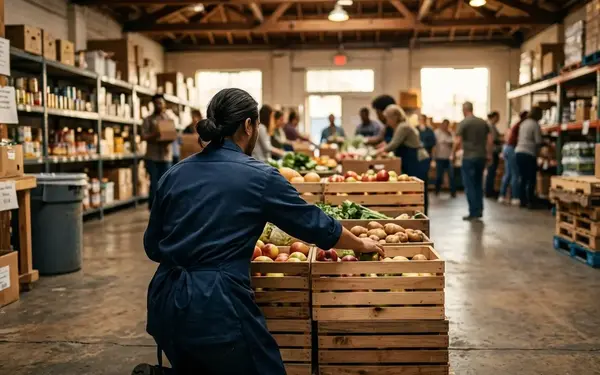
Growers preparing harvests for regional showcases organized by ASAP or supplying community outlets supported by West Village Market's donor and partner networks can target shade-tolerant berries, culinary herbs, and head lettuce under elevated panels. Matching crop selection to the filtered light profile preserves marketable leaf quality through August while keeping small-acreage land in commercial food production.
Soil Compaction, Topsoil Stripping, and Stormwater Safeguards on Sloped Land
Conventional solar site preparation poses a severe threat to mountain farmland before a single module is bolted into place. Permanent agricultural damage rarely comes from the solar panels themselves; it stems from civil earthwork. When excavation contractors conduct mass grading to flatten a rolling slope, they strip away the biologically active topsoil horizon and expose dense clay subsoils. Repeated passes by heavy scrapers, concrete trucks, and skid steers across damp clay compress pore spaces, destroying water infiltration capacity and accelerating sheet runoff into downslope waterways.
To prevent irreversible soil degradation, county land-use standards must regulate how arrays are anchored and how equipment moves across the site. Driven steel piles for ground-mount racking typically reach 6 to 10 feet deep. Where deep alluvial or colluvial soils allow full embedment, driven piles require no concrete footings, leaving the surrounding soil profile intact for root penetration and eventual farm restoration. However, soil and stormwater safeguards stop at the point where driven piles hit shallow bedrock on the county's ridges and upper slopes. Past that point, the no-concrete, no-mass-grading standard needs a site-specific geotechnical exception, which the coalition asks the county to require in writing rather than grant informally. On those shallow-bedrock sites, engineers may need to specify predrilling, helical ground screws, or surface ballasted footings rather than defaulting to mass excavation.
Mandatory Earthwork and Soil Testing Protocols
- Georeferenced Baseline Soil Testing: Complete comprehensive sampling 3 to 6 months prior to any ground disturbance. Testing must record soil organic matter, pH, bulk density, and penetrometer resistance at both the 0-to-6-inch and 6-to-12-inch depths across georeferenced grid points that inspectors can revisit post-construction.
- Wet-Weather Traffic Halts: Confine heavy delivery and construction vehicles to designated haul lanes and mandate an immediate work stoppage after significant rainfall until clay-rich soils drain—a pause that typically requires 24 to 72 hours in Western North Carolina.
- Topsoil Stockpiling Limits: Where limited grading is unavoidable for inverter pads or access roads, strip and stockpile topsoil in mounds no higher than 4 to 6 feet to preserve aerobic soil biology. Seed all stockpiles with a protective cover crop within 14 to 30 days of stripping and respread the soil prior to the September-through-October fall seeding window.
- Post-Installation Compaction Remediation: Re-measure penetration resistance at the original georeferenced points after racking assembly completes. Penetrometer readings exceeding roughly 300 psi restrict crop and forage root growth; site permits should set 300 psi as the mandatory trigger requiring corrective deep subsoiling or biological tillage during the first 1 to 2 growing seasons after construction.
Structuring Farmer Access, Liability, and Multi-Year Land Tenure
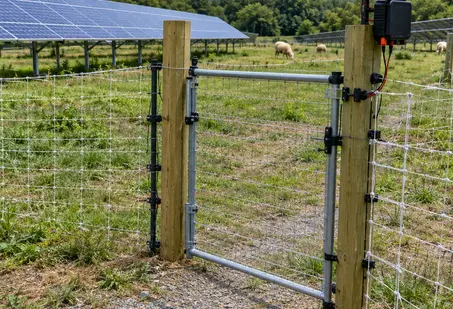
I once walked a newly permitted solar array in the region where the developer had promised sheep grazing to satisfy county reviewers, yet the perimeter gates were barely ten feet wide and the nearest water spigot sat four hundred yards uphill across a busy road. In Buncombe County, the first thing to fail in a solar co-use permit is usually not the panels but the grazier's access. Within a season or two of approval, an array built with security-only fencing, narrow gates, and no water at the paddocks becomes a mowed lot, because no one can practically bring a trailer of sheep onto it.
This physical failure mirrors a deeper contractual disconnect. Energy developers negotiate land leases directly with property owners. Tenant farmers who previously worked that ground on handshake agreements or annual cash rents are excluded from the transaction, losing their acreage overnight. Preserving farm livelihoods requires bringing the agricultural operator into the legal structure from day one through a three-party land lease or a multi-year vegetation management contract tied directly to the special-use permit. Securing multi-year land tenure is essential for beginner and historically underserved growers whose harvest sales help sustain local nutrition incentives like Double Up Food Bucks at county farmers markets—a point reinforced in discussions with Gina Smith, Program Coordinator.
To make dual-use arrays commercially workable for local livestock and crop producers, site plans and legal agreements must incorporate specific infrastructure and insurance boundaries:
- Livestock-Grade Perimeter Fencing: Standard chain-link security fencing often leaves gaps along uneven mountain grades where coyotes or stray dogs can enter and sheep can push underneath. Specifications should require 4-to-5-foot woven wire livestock fencing with a tight bottom edge, supplemented by an offset interior electric strand to deter predators.
- Trailer-Compatible Gate Widths: Perimeter entrances and interior paddock transfer gates must measure at least 12 to 16 feet wide so operators pulling standard gooseneck or bumper-pull livestock trailers can swing through turns without clipping gateposts or solar trackers.
- Plumbed Paddock Watering Systems: Sheep consume roughly 1 to 2 gallons of water per head daily, and lactating ewes grazing during summer heat spikes require even higher volumes. Developers must install frost-free hydrants or buried water lines serving each sub-paddock during initial trenching so farmers are not forced to haul water tanks by truck.
- Five-to-Ten-Year Grazing Contracts: Vegetation management agreements should run on 5-to-10-year terms with built-in annual rate reviews, paying graziers fair market rates for vegetation control so they have the financial security to expand flock size and purchase handling equipment.
- Explicit Liability Separation: While graziers commonly carry standard farm general liability coverage around $1 million, the co-use contract must explicitly state that property and casualty insurance covering high-voltage panels, inverters, and underground collection lines remains the sole responsibility of the energy project owner.
How to Submit Public Comment on Buncombe County Solar Permitting Rules
Translating field agronomy into county law requires using the specific regulatory tools available to local government. Special-use permit conditions attach enforceable operational rules directly to the parcel deed. Agricultural zoning overlays establish baseline design expectations before a developer ever sketches a site layout. Financial decommissioning bonds guarantee that when an array reaches the end of its 25-to-35-year lifecycle, funds are held in escrow to remove steel pilings, decompact haul lanes, and return the soil to full agricultural readiness.
Because salvage values and earthwork costs shift over decades, county ordinances should require decommissioning bonds to be recalculated every 5 years to keep pace with inflation. A permit condition is only as durable as its inspection schedule. Without ongoing verification, dual-use commitments frequently decay into unmowed weeds once construction crews depart—a concern highlighted in notes compiled by Katie Souris, Food Policy Council representative. Buncombe County can prevent permit drift by requiring annual co-use verification between May and September, combining a written grazing or cropping plan for the upcoming season with a field inspection or dated photographic record confirming livestock or harvested crops on the ground.
Katie Souris: Council Representative Hearing Tip
Public comment periods at Buncombe County board and commission meetings are typically restricted to 3 minutes per speaker. Preparing a concise statement built around three concrete ordinance amendments—and handing printed copies to the clerk before speaking, carries far more weight during markup sessions than broad philosophical testimony.
Ordinance revisions move through the Buncombe County Planning Board for technical review before advancing to the Board of Commissioners for a final vote. Submitting formal feedback 1 to 3 months before a scheduled commission vote gives staff planners time to write technical standards directly into the draft ordinance text.
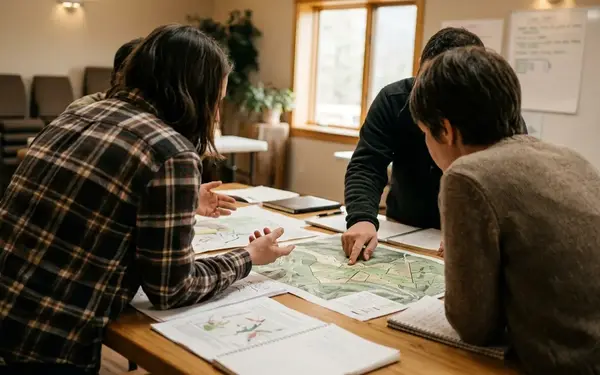
Send a written email and register to speak at the next Buncombe County Planning Board and Board of Commissioners land-use review session, demanding that three mandatory conditions be written into the county solar permitting ordinance: first, a prohibition on mass grading and topsoil stripping on prime and statewide-important farmland, backed by georeferenced baseline soil testing and a 300-psi post-construction compaction remediation trigger; second, mandatory agricultural infrastructure on all dual-use site plans, including 12-to-16-foot trailer gates, 4-to-5-foot woven-wire livestock fencing, and plumbed paddock water lines; and third, enforceable agricultural co-use covenants verified annually between May and September alongside a decommissioning bond recalculated every 5 years to fund complete soil decompaction and reseeding.






Responses
No comments yet.
Write a Comment