
Every spring, someone asks the Asheville Buncombe Food Policy Council (ABFPC) a version of the same question: if we only had the political capital for one ask this year, what should it be? The honest answer depends less on which policy sounds most ambitious and more on how long it takes a vote to become food on a table or money in a grower's account.
So we stopped ranking levers by how much enthusiasm they generate in a room and started ranking them by time-to-plate.
Which Lever Puts Food on a Plate Fastest?
Sort every tool available to Asheville City Council and the Buncombe County Board of Commissioners into three buckets. The first holds code changes that merely permit future activity. The second holds spending decisions that redirect existing dollars inside a single fiscal cycle. The third holds regulatory and permitting fixes that lower the cost of entry for people already trying to sell food.
Both governments run on North Carolina's July 1 to June 30 fiscal year. That single fact does most of the sorting work. A procurement change adopted in a June budget ordinance starts shaping purchase orders within the first full quarter of the new year. A Unified Development Ordinance text amendment typically runs four to nine months from first staff draft through Planning and Zoning Commission review to Council adoption, and then waits on a grower, a lease, and a growing season before anything is harvested.
Access points are not scarce. Council meets on the second and fourth Tuesdays, the Commissioners on the first and third, which gives advocates roughly 24 scheduled entries per body per year before anyone counts work sessions or advisory board meetings. The scarce resource is sequencing.
Reading the Use Table the Way a Code Officer Reads It
Most zoning audits in the food space start by asking whether the ordinance mentions agriculture. That question produces reassuring answers and almost no usable information.
Pull the district use table instead and check four entries: community garden, market garden or urban farm, greenhouse or hoop structure, and on-site produce sales. For each one, note whether the use is permitted by right, permitted with conditions, allowed only by special use permit, or simply absent. Absence is the common case, and an absent use is a prohibited use in the hands of an enforcement officer.

The jurisdictional wrinkle here deserves a map of its own. North Carolina's bona fide farm exemption shields qualifying farm operations from county zoning, but it does not reach municipal zoning inside city limits. The same hoop house or chicken coop can be untouchable on one side of the city line and a violation on the other. Draft ordinance language before you have mapped that split and you will spend months fixing a problem that was never yours to solve.
Backyard livestock provisions in ordinances of this type generally cap hens in the single digits, prohibit roosters outright, and set coop setbacks somewhere in the 15 to 25 foot range from adjoining dwellings. Advocates fight over the hen count. The setback is what actually disqualifies narrow in-town lots, and it is the number worth negotiating.
Before the First Raised Bed
Legalizing cultivation does nothing about what is already in the ground or what comes out of the tap. Parcels along former rail, fill, and light-industrial corridors can carry lead and arsenic loads that no use table addresses, and many candidate lots have no metered irrigation connection at all. Routine fertility and heavy-metal screening through the state agriculture department's lab is free from April 1 through November 30 and carries a small per-sample fee from December 1 through March 31, with results typically back in two to four weeks off-season and considerably slower in the January and February backlog. Raised beds, imported growing media, and tested water sources are a separate line of policy work with its own budget.
Following a Head of Cabbage Back to the Field
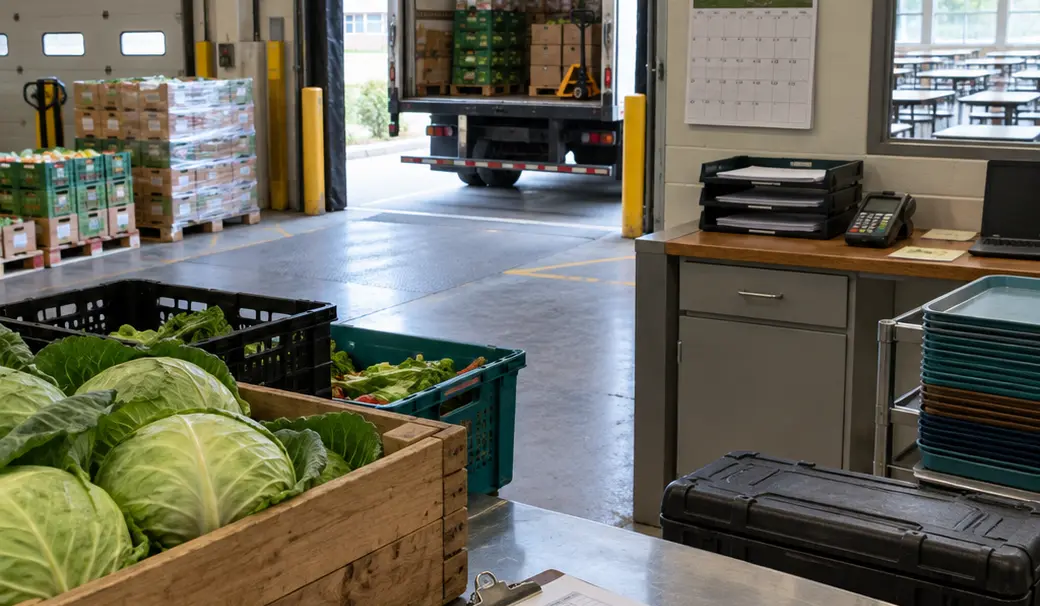
The strongest procurement argument comes from tracing one item backward from the serving line and marking every point where a regional grower gets eliminated. Price is rarely the reason. The eliminations happen at the insurance certificate, at the third-party food-safety audit requirement, at the case-pack specification, at the delivery window, and at payment terms.
This is the aggregation gap, and it sits entirely downstream of land-use code. A Buncombe grower can clear every hurdle in the Unified Development Ordinance and still lose the account at a 6:00 to 9:00 a.m. dock window and net-30 invoicing, because most school kitchen and detention facility docks accept freight only in that narrow early-morning slot, in standardized case packs, with payment arriving a month later rather than on delivery. Food hubs and shared cold storage exist to close exactly these five failure points.
State purchasing law sets the boundaries of local discretion. Informal bidding procedures attach to purchase contracts beginning at $30,000; formal sealed bidding with advertised notice is required at $90,000 and above, where award goes to the lowest responsible bidder. Below $30,000, departments have genuine latitude to specify regional sourcing, and that sub-threshold tier is where direct contracting belongs. Federally funded school nutrition programs may apply a geographic preference for unprocessed or minimally processed local items under USDA resources on local food systems procurement rules, purchase without competitive quotes up to the $10,000 federal micro-purchase threshold, and use simplified small-purchase procedures up to $250,000.
Timing kills more local sourcing deals than regulation does. Cafeteria menu cycles and bid specifications are typically set five to seven months ahead, so a forward contract covering August through October deliveries has to be negotiated in January and February, before seed orders go in.
The Permit Stack a Mobile Vendor Actually Carries
Advocates routinely spend a year lobbying City Council over a rule written in Raleigh. Separating requirements by issuing authority prevents that waste. Food safety standards for restaurants, mobile units, and shared-use kitchens come from the state food code and are enforced locally by county environmental health staff; local government cannot rewrite them, but it controls fees, zoning authorization, application design, and scheduling.
A mobile food vendor assembles a stack rather than a permit: a county environmental health permit for the unit, a signed commissary agreement with a permitted kitchen, fire inspection for propane and suppression systems, and separate municipal zoning authorization for each site type, each with its own form and its own counter. Consolidating those counters is squarely within local control.
Plan review for a new or substantially remodeled food establishment commonly runs 10 to 15 business days before an opening inspection can be scheduled. Temporary event vendor applications generally must be filed at least 15 days before the event date.
Fifteen Days Out
Organizers of community markets and celebrations like ASAP's Local Food Experience lose vendors to that 15-day filing rule more often than to weather. Build the application deadline into the event timeline, not the week-of checklist.
For value-added producers, the state home-processing route allows shelf-stable, non-potentially-hazardous goods such as baked items, jams, and dry mixes from a home kitchen after a state agriculture department inspection, with no facility permit fee. Acidified foods, canned low-acid vegetables, and anything requiring refrigeration fall outside it and push the producer into a permitted commercial or shared-use kitchen. Shared-use rentals in this market bill hourly with a minimum block and require proof of liability coverage plus a separate storage agreement, so the true entry cost includes insurance and dry or cold storage, never just the hourly rate.
Who Holds the Pen, Who Writes the Check
Ask one question of any proposal: who writes the check, or who holds the pen? Public health permitting, the detention facility's food contract, social services programs, and zoning outside municipal limits belong to the county. The Unified Development Ordinance, city-owned parcels, city facility and event catering, and municipal business licensing belong to the city.
The standard path runs advisory body recommendation, staff feasibility review, work session briefing, formal agenda item with public hearing, then vote. Realistically that consumes three to five regular meeting cycles, roughly four to eight months, with no organized opposition at all. Legislative zoning amendments add published notice once a week for two successive weeks and mailed notice to affected property owners between 10 and 25 days before the hearing. Public comment at regular meetings of both bodies is typically capped at three minutes per speaker with sign-up before the meeting opens.
Two limits belong in every advocate's briefing packet. A local-preference clause in a county budget ordinance cannot override the lowest-responsible-bidder rule attaching to formal purchase contracts at $90,000. And school meal sourcing sits with a self-supporting nutrition enterprise fund that neither Council nor the Commission can bind by resolution. Pretending otherwise burns credibility that takes a budget cycle to rebuild.
April Beats June
The manager's recommended budget is filed with the clerk by the start of June at the latest, must be publicly available at least ten days before the required hearing, and the ordinance must pass before July 1. Testimony at the June hearing lands on a document already written. Comments delivered in April or early May, while departmental requests are still being assembled, change line items.
Put a Percentage Floor in the Budget Ordinance
This recommendation reverses the sequence we first drafted. The original toolkit led with a zoning package: market gardens by right, expanded backyard livestock allowances, farm stands permitted in residential districts, on the reasoning that land access is foundational and code reform is cheap because it moves no money. Tracing the cabbage changed the order. Land that is legal to farm still loses the sale at the insurance certificate.
Advocates should put binding public procurement mandates ahead of incremental zoning work this cycle. Write the mandate as a percentage-of-spend floor on specified food categories, phased by year, applied to city and county facility catering and detention food contracts, with annual public reporting of dollars spent by vendor and county of origin. Aspirational language without a reporting requirement is unenforceable, and it should be refused at the drafting stage rather than fixed later.
Give the mandate a three to four year phase-in. That is roughly the interval a mid-size vegetable operation needs to add cold storage, obtain a food-safety audit, and scale plantings against a contract, and it matches the renewal cycle of most multi-year institutional food service agreements. Above the formal bidding threshold, the durable mechanism is the product specification: harvest-to-delivery intervals, variety, seasonal availability windows. Reserve the sub-threshold tier for direct regional contracting.
Local food purchasing belongs in the regional economic development column of the budget, alongside road maintenance and workforce programs, with the same expectation of measurement. Take the ask to the Commission in April. Name a number, name the categories, and demand the vendor report.







Responses
No comments yet.
Write a Comment