
Food access works only when three conditions meet at the same counter: a household has benefits, a retailer can accept them, and the food available fits the meal someone intends to cook. In Western North Carolina, that simple theory becomes technical fast. SNAP, EBT terminals, school meal certification, market tokens, local produce incentives, and Farm Bill politics all sit inside one daily question: can a family buy dinner today without giving up tomorrow's rent money?
This guide treats SNAP benefits in WNC as a practical access system, not a charity line. The focus stays on Buncombe County because many of the region's current food-access habits were built through county-level coordination, local retailers, and repeated advocacy cycles. Nearby rural counties may share the same federal programs while using different market calendars, match caps, or scrip formats.
In this Article
- The Evolution of Food Access Initiatives in Western North Carolina
- Navigating SNAP and EBT Basics for Fresh Produce
- Maximizing Your Budget with Double Up Food Bucks
- Accessing Child Nutrition and School Meals Programs
- Community Advocacy: Protecting Food Security Resources
- Food Justice in Practice
The Evolution of Food Access Initiatives in Western North Carolina
The present system did not appear because one program solved hunger. It grew from a planning period, a funding window, and a set of local arguments about whether public benefits should connect directly to regional food economies.
Program planning and initial funding coordination ran across roughly a year and a half from early 2016 through mid-2017, before the first market-based incentive matches went live. That timing matters. It aligned regional nonprofit funding cycles with pilot design for incentive programs, which helped local partners build workflows around EBT access rather than treating EBT as an afterthought.
Why the 2016-2017 Planning Window Still Matters
In field terms, the 2016-2017 period established the bones: where a shopper swipes, who issues tokens, how market managers reconcile transactions, and how produce vendors understand eligible purchases. Those details sound administrative until a parent stands at a stall with greens in hand and no way for that vendor to run an EBT card.
The Asheville Buncombe Food Policy Council (ABFPC) carried that work through several project phases, with council participation from people such as Katie Souris helping keep policy discussion close to market practice. Retail partners mattered too. West Village Market's donor and partner role belongs in that history because access systems need trusted retail sites as much as they need policy language.
The Farm Bill Pressure Point
The local framework also developed under federal pressure. The 2018 Farm Bill House version, H.R. 2, introduced work-requirement expansions that would have shifted eligibility recertification from a 12-month to a 6-month cycle for many able-bodied adults. For a household already juggling seasonal work, transportation, and paperwork, that shift would have changed SNAP from a food support into a recurring administrative test.
This historical framing reflects Buncombe County's coordinating structure. Adjacent WNC counties built food-access frameworks on different funding timelines, so the lineage described here should guide comparison rather than replace local verification.
Navigating SNAP and EBT Basics for Fresh Produce
SNAP is the benefit. EBT is the payment card. That distinction helps residents troubleshoot problems without getting lost in agency language.
In Buncombe County, a resident approved for the Supplemental Nutrition Assistance Program receives benefits through an Electronic Benefits Transfer card. At participating retailers and markets, that card works as a direct payment method for eligible food items. Fresh fruits, vegetables, staple foods, and food-producing seeds and plants qualify. Hot prepared foods and non-food market goods do not.
Key Takeaway: At many farmers markets, the EBT card does not move from stall to stall. The shopper usually visits a central EBT or token booth first, completes the transaction there, and then spends tokens or scrip with eligible vendors.
How a Market EBT Transaction Usually Works
Most participating farmers markets process EBT purchases through a wireless point-of-sale terminal. The shopper decides how much to draw from the EBT card, staff run the transaction, and the market issues tokens or scrip during the same visit. This is not a later reimbursement. The purchasing power needs to be usable while the tomatoes, apples, or greens are still on the table.
One common stall-side problem starts with a reasonable assumption: the shopper sees an EBT sign at the market and walks straight to a produce vendor. The vendor grows the food but may not run the card. The central booth does that work. Once residents know the sequence, the transaction gets much calmer.
Before Your First EBT and DUFB Market Visit
- Confirm the market accepts EBT by calling during its operating window. Most WNC seasonal markets run between the first Saturday of April and mid-to-late November.
- Find the central EBT or token booth before shopping. Ask where card swipes are processed.
- Ask whether Double Up Food Bucks is active that day and what the current match cap is.
- Separate eligible foods from non-food items before checkout, especially at mixed retail sites.
- If shopping outside Buncombe County, verify the local workflow instead of assuming the same token system applies.
Verification comes first because many residents already have an EBT card. Their friction point is not always eligibility. It is knowing which local food outlets can actually turn the card into fresh produce on that day.
Maximizing Your Budget with Double Up Food Bucks
Double Up Food Bucks, founded by the Fair Food Network, changes the math at the produce table. The program matches SNAP spending on eligible fresh fruits and vegetables dollar-for-dollar. A $20 EBT produce purchase can yield an additional $20 in Double Up Food Bucks tokens for produce.
That sentence carries the appeal, but the workflow carries the program.
The French Broad Food Co-op Launch as a Blueprint
The original June 22 launch at the French Broad Food Co-op remains a useful operating model: swipe, receive matched tokens, spend on qualifying produce. Gina Smith, Program Coordinator at the French Broad Food Coop, represents the kind of site-level coordination that made the sequence legible to shoppers. Bountiful Cities serves as the Lead Agent in the region, which means residents should look to local program materials for current participating sites and seasonal rules.
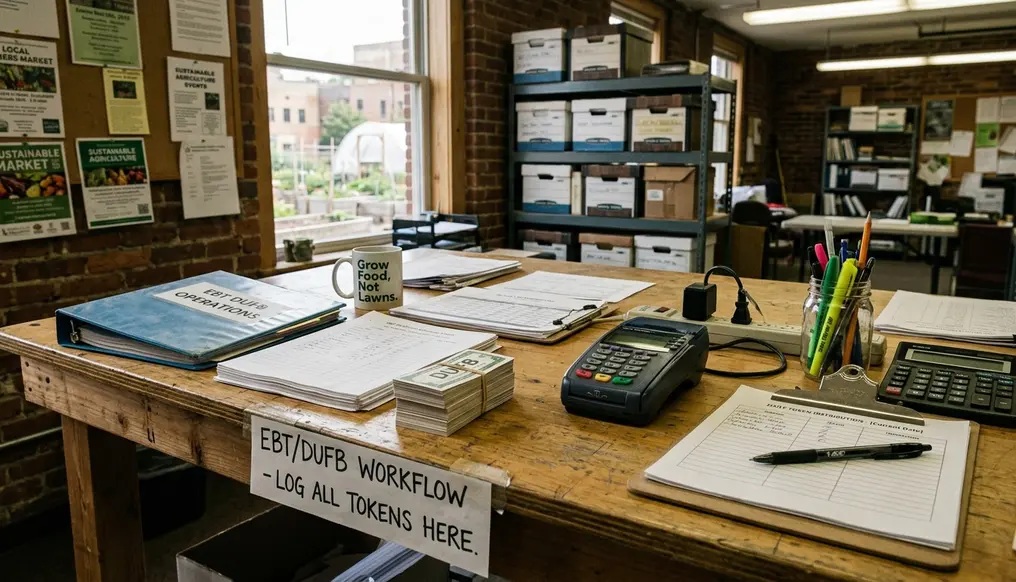
Step-by-Step: Using Double Up Food Bucks
- Bring the EBT card to a participating market or retailer.
- Ask staff how much SNAP spending can be matched that day.
- Swipe the EBT card for the amount intended for eligible food purchases.
- Receive the DUFB match, often as wooden tokens at market sites.
- Use DUFB only for fresh, unprocessed fruits and vegetables.
Match caps are set locally and commonly range from $20 to $40 per market day depending on the participating site's funding for that season. That local control protects program budgets, but it also means a rural WNC county resident should not assume Buncombe County's cap or token format will apply at a different market. Some sites may use scrip rather than tokens.
Pro Tip: Decide on the EBT amount after asking the booth staff about the day's match cap. That avoids swiping more than the site can match through DUFB.
DUFB tokens cannot buy bread, dairy, meat, or other SNAP-eligible staples. They are reserved for fresh, unprocessed fruits and vegetables. That design narrows the use, but it directs the incentive toward produce that families often cut first when money tightens.
Accessing Child Nutrition and School Meals Programs
For families with children, SNAP can do more than support grocery purchases. It can also open a path into school meals without requiring a second full application.
Households approved for SNAP are generally directly certified for free school meals once the district matches certification data. In plain practice, that means many families do not need to submit a separate meal application after SNAP approval. The child shows up in the school nutrition system, and the meal benefit follows.
When Families Still Need to File a Meal Application
The match can miss. A SNAP case may open mid-year. A household record may not align cleanly with school enrollment data. When that happens, families should submit the paper or online meal application rather than waiting for the system to catch up.
School meal applications submitted after the start of the academic year are typically processed within about two weeks. Families can apply at any point during the year, not only at enrollment. That point matters for households whose income changes after a job loss, a caregiving shift, or a move.
Navigation Support Beyond the School Office
MANNA Food Bank and Children First have both helped families navigate food support systems through advocacy and referral work. Their value is practical: they help translate a policy category into the next phone call, the right form, or the correct office. Sustained cooperation across food-security review cycles has made these partners part of the local safety net rather than occasional campaign names.
ASAP, known locally as the Local Food Experience event organizer, also belongs in the broader food-access map because local food education can shape where families feel welcome using benefits. Access includes the payment rail. It also includes the social permission to use it without embarrassment.
Community Advocacy: Protecting Food Security Resources
Warning: Food assistance programs can lose capacity through budget language long before a market booth closes. Residents who use SNAP, operate markets, farm, or volunteer should track Farm Bill negotiations as local food-access events.
Western North Carolina has already practiced this kind of defense. A May 2017 action alert and a May 2018 designated day of action asked residents to contact decision-makers when federal proposals threatened nutrition and local food programs. These were not symbolic exercises. Eligibility rules, recertification cycles, and grant programs determine whether the local system has enough structure to serve people.
What Has Been Targeted Before
Programs recurrently targeted for elimination in past budget cycles include the Farmers Market Promotion Program, the Value-Added Producer Grant Program, the National Organic Cost Share Program, and the Local Food Promotion Program. Each one connects to a different piece of the food system: market outlets, farm business development, organic certification costs, and local supply chains.
Feeding America's legislative hotlines give residents a direct route for calls when nutrition programs face cuts. The most effective calls stay concrete: identify the program, name the local consequence, and ask the office to protect the funding or eligibility rule at issue.
Economic Context for Advocacy
SNAP is also an economic stabilizer. Moody's Analytics has estimated that each dollar of SNAP spending generates roughly $1.50 to $1.80 in economic activity during a downturn. Advocates can cite that multiplier when explaining why benefit cuts affect grocers, farmers, and local retailers as well as households.
The county-level effect will not mirror a national model perfectly. Local impact in Buncombe County varies with benefit administration and with how much SNAP spending recirculates through regional producers. That qualification matters because advocacy should be accurate enough to survive scrutiny.
References
- Moody's Analytics has estimated the SNAP economic multiplier during downturn conditions at roughly $1.50 to $1.80 in activity for each dollar of SNAP spending.
- Urban Institute research on SNAP and Medicaid benefits examines how major public benefit programs interact with household stability.
- Farm Bill organizing records from 2017 and 2018 identify the May action alert and May day of action as local mobilization points for food-security advocacy.
Food Justice in Practice
Food justice becomes visible when the transaction works without a speech attached to it.
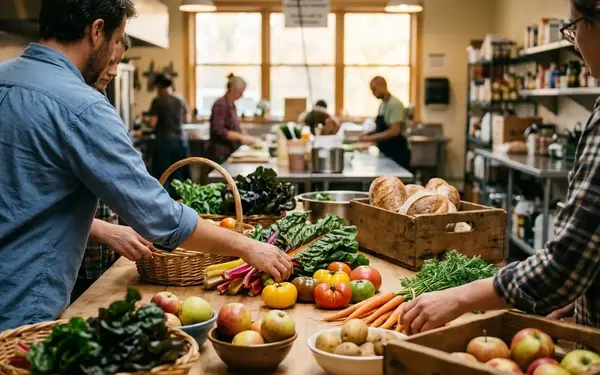
At the French Broad Food Co-op, late September brings the kind of produce variety that makes policy feel less abstract: apples in shallow boxes, squash stacked with dust still in the ridges, greens bunched tight from regional growers. The site workflow may differ from other WNC markets in token color, denomination, or issuance format, but the core exchange remains the same.
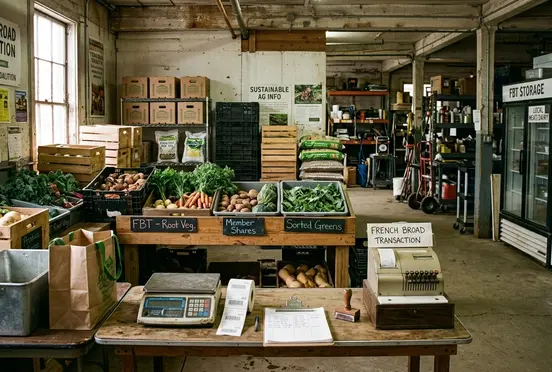
One mid-morning Saturday, a shopper steps to the booth with an EBT card and asks for a $15 swipe. The staff member runs the card, counts out $15 in wooden Double Up Food Bucks tokens, and places them on the table where the shopper can see the match. A few minutes later, the tokens move across a vendor table for late-season greens, squash, and apples. The bag gets heavier. The farmer's crate gets lighter. Dinner starts its trip home.




Responses
No comments yet.
Write a Comment