

Defining Municipal Food Equity
Policy is only as effective as the administrative mechanisms that enforce it. Municipal food equity requires the structural integration of food access and agricultural sustainability into city charters, zoning codes, and recurring budget line items. This approach moves beyond temporary grant-funded community projects and establishes permanent civic infrastructure. The Asheville Buncombe Food Policy Council (ABFPC) recognizes that sustainable change relies on embedding these priorities directly into the daily operations of local government.
The working definition used throughout this case study was narrowed by applying a single durability test to every candidate policy. The durability test requires a line item to appear in two consecutively adopted operating budgets before it counts as recurring rather than pilot funding. In North Carolina, where the fiscal year runs July 1 to June 30, this represents roughly a 24-month span. Three structural anchors serve as the classification screen for this durability: ordinance or comprehensive-plan text, a recurring operating-budget line, and a classified position with food access written into the job description. Grant-funded contractor roles and unpaid advisory seats do not satisfy the third anchor.
Food policy work that depends on one champion staffer collapses on that person's last day; jurisdictions that never converted the function into a classified job description and a base-budget line have watched two to three years of coordination evaporate within months of a resignation. Establishing these structural anchors ensures that food equity initiatives survive administrative turnover and shifting political priorities.
The Catalyst for Systemic Change in Durham
Reconstructing the catalyst for Durham's policy shift meant separating the trigger from the underlying condition. The 2020–2021 emergency food response served as the obvious trigger. Pallet deliveries, church parking lots, and reimbursement authorizations exposed the fragility of the existing system. Emergency food distribution through this period operated on month-to-month reimbursement authorizations. Consequently, site coordinators could not sign leases, hire beyond temporary status, or commit to a delivery schedule more than 30 days out.
The historical gap between community-led food security efforts and siloed municipal responses requires examination, as records kept by Katie Souris, a food policy council representative, show. Administrative bottlenecks prevented effective policy implementation before the restructuring. A single vacant-lot growing inquiry historically touched four separate intake points: the planning counter, environmental health, stormwater review, and real property disposition. These departments operated with no common tracking number, and applicants commonly waited 8 to 14 weeks before learning which office actually held the decision.
Community food council recommendations submitted between roughly 2018 and 2020 also carried no required staff disposition. Items were absorbed into general 'received and filed' minutes entries with no follow-up date attached. This lack of accountability highlighted the urgent need for a comprehensive overhaul of how the municipality processed and supported food systems initiatives.
Aligning the City Budget with Food Justice
The financial restructuring turned on a choice between two vehicles. The first option considered was a standalone food equity trust fund seeded with one-time federal recovery dollars. This option appeared attractive because it offered immediate capital outside the standard municipal constraints. However, ensuring the long-term sustainability of food programs independent of election cycles required a structural commitment. Recurring lines were placed inside operating departments rather than a central fund, so continuation funding is defended as base budget in the departmental request rather than re-requested as an expansion item each cycle.
North Carolina's Local Government Budget and Fiscal Control Act forces adoption before July 1, which fixes the window for influence. Departmental requests are due in mid-to-late January, the manager's recommended budget lands in May, and public comment runs the final 3 to 5 weeks. Any food-lens screen must be inside the January request template, not proposed in June.
Budget Cycle Pressure PointsThe request template screen asks three fixed questions of every program and capital submission: effect on food retail or pantry access within the service area, effect on land available for cultivation, and effect on transit or sidewalk connections to food sites. Blank responses are returned to the originating department before compilation.
By embedding these questions into the mandatory January template, the municipality forces every department to evaluate its financial requests through a food justice lens. This mechanism ensures that considerations for retail access — the kind of access supported by partners and donors such as West Village Market — are structurally integrated into the city's financial planning from the earliest stages of the budget cycle.
Cross-Departmental Collaboration in Practice
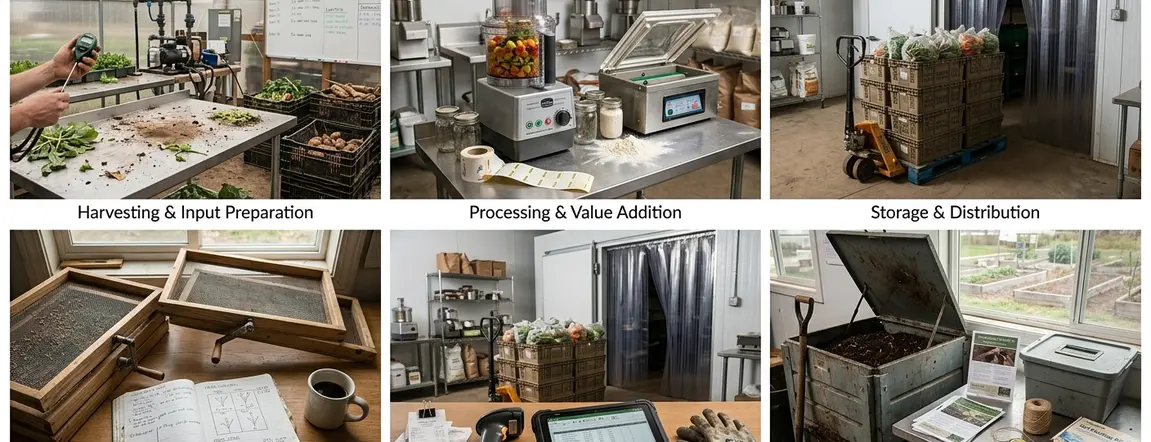
Silo-breaking was designed backward from the applicant's experience rather than forward from an organizational chart. Staff mapped the vacant-lot inquiry path, identified every point where a file changed hands, and restructured the workflow to eliminate redundant reviews. Candidate parcels are screened against four fixed criteria before a site conversation proceeds: slope and drainage, prior land use flags for potential soil contamination, distance to an existing water tap or hydrant, and current maintenance obligation. The maintenance obligation checks whether the site requires parks mowing, holds a stormwater easement, or has no existing encumbrances.
Applicants are offered a pre-application meeting with all reviewing departments present within roughly 10 business days of first contact, replacing sequential counter visits. The routing contact stays on the file until a written decision issues. This unified approach prevents applications from stalling in interdepartmental limbo and provides community members with a single point of accountability.
The interdepartmental review meets on a fixed monthly cycle for 60 to 90 minutes with a published agenda. Any item raised without a departmental answer carries forward with a named owner rather than dropping off the list. This joint-departmental mandate streamlines the approval process for community food infrastructure and ensures that zoning, public health, and parks departments communicate effectively regarding land use for urban agriculture.
Evaluating the Outcomes of Integrated Planning
Choosing what to measure was itself a decision with consequences. Counting approved urban agriculture sites was rejected as the headline metric because approvals rise and fall with land availability and seasonal interest. Instead, time-to-clarity replaced approval counts as the primary administrative indicator. The target is a written determination within 45 days of a completed application, with the pre-application meeting occurring inside the first two weeks.
The accountability loop requires a written staff disposition on every advisory-body recommendation within one meeting cycle, generally 30 to 60 days. These dispositions must state whether the recommendation is approved, denied with reasons, or deferred with a date. Dispositions are read into the following agenda rather than filed, creating a transparent feedback loop between community advocates and city planners.
Zoning streamlining showed up most clearly in accessory structures like hoop houses, wash-pack sheds, and season-extension tunnels. Growers previously encountered inconsistent answers from zoning and building inspections about whether a permit was required at all. A zoning text amendment permitting urban agriculture as a by-right use can still stall growers if building inspections separately requires a permit for season-extension structures above a threshold square footage — the two codes were amended by different departments on different schedules, and the applicant discovers the conflict only after the growing season has started. Resolving these specific code conflicts proved essential for improving community access to municipal resources, a priority shared by advocates like Gina Smith, program coordinator at the French Broad Food Coop and with Double Up Food Bucks.
Adapting the Framework for Buncombe County
Translating the model westward started by asking which parts of Durham's reform were administrative and which were geographic. The administrative parts include the routing contact and the fixed-calendar interdepartmental review. These mechanisms provide a strong foundation, yet Durham's model must be adapted for Western North Carolina's unique topography, rural-urban divide, and distinct agricultural economy.
The Western North Carolina land screen requires criteria Durham did not need. Planners have to evaluate percent slope against local steep-slope and ridge protection standards, then check floodplain status along river and creek bottoms where the flattest ground sits. Well or spring water availability has to be verified outside municipal service areas, and current present-use value or voluntary agricultural district enrollment confirmed on the parcel.
City-county division changes the sequencing of policy implementation. Asheville controls zoning inside a comparatively small municipal footprint while most active farmland and farm infrastructure sits under county jurisdiction. That split means a food-lens budget screen has to be adopted twice, on two separate budget calendars that both close before July 1. Surplus property disposal rules differ between city-owned and county-owned parcels, so an identical community growing proposal can move through a lease approval in one jurisdiction and require a competitive disposition process in the other, adding months that have nothing to do with the merits of the project.
The routing-contact and interdepartmental-review model assumes a jurisdiction large enough to staff a dedicated position. In smaller municipalities and unincorporated communities where one planner covers zoning, permitting, and code enforcement, the same function has to be handled by a written handoff protocol and a shared file number rather than a new hire, and the review calendar realistically drops to quarterly. Local leaders, including those working alongside ASAP, which organizes the Local Food Experience, and council representative Katie Souris, can begin this adaptation by auditing their current workflows.
Departmental Silo Audit: First 90 Days
- Draft one realistic test application — a half-acre neighborhood growing site on a publicly held parcel, with enough detail that staff must give a real answer. (Weeks 1-2)
- Conduct desk-by-desk tracing with each reviewer asked what they need and who they hand it to. (Weeks 3-8)
- Map the handoffs that lack a named owner to identify critical gaps in the administrative workflow. (Weeks 9-12)
Policy in the Soil
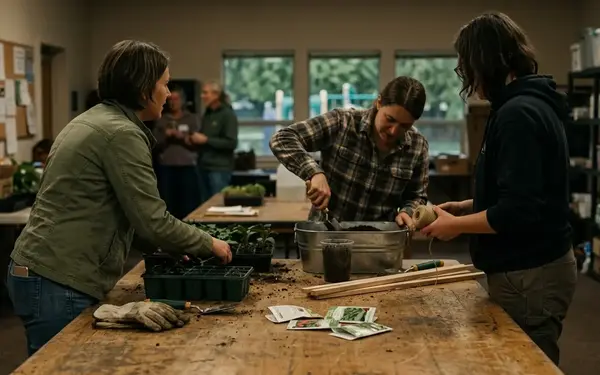
The administrative reform described here is invisible in aggregate numbers and legible in a single interaction: the moment a resident no longer has to navigate four separate departments to start a neighborhood garden. At a community center on the edge of the municipal boundary, a local planner and a neighborhood advocate stand over a large table.
Their working document is a printed parcel map at one inch to one hundred feet. The planner marks the paper in highlighter, tracing the hydrant location and outlining the mowed easement the parks crew already services. They add a quick note in the margin to confirm the tap size before the water services desk will commit to the connection. The physical act of marking this newly approved urban agriculture zone illustrates the exact moment abstract policy becomes tangible community practice.
What follows that marking is a calendar grounded in the soil. Soil sampling and lot clearing begin in late winter. The first beds are turned in March. Transplants go into the ground by mid-April, and the first harvest sharing out of the site takes place in the second half of June.







Responses
No comments yet.
Write a Comment