
Why Buncombe Must Count Food Twice
How much local landfill space and public money are consumed by food that could have fed a neighbor or enriched Western North Carolina soil?
That question opens two ledgers. The first tracks airspace at Buncombe County’s landfill off Panther Branch Road in Alexander, roughly a 20- to 25-minute haul north of downtown Asheville for transfer traffic. The second tracks the public and private costs embedded in every discarded bag of greens, hotel pan of rice, and cosmetically rejected crop.
Food waste often enters public discussion as an environmental concern. In practice, it also exposes failures in purchasing, transportation, hunger prevention, land-use planning, and municipal finance. A tray of prepared food can still serve its intended purpose if a refrigerated vehicle reaches the loading dock in time. Hours later, that same tray becomes compost feedstock. Once buried, it consumes landfill capacity and generates methane under anaerobic conditions.
The order of intervention therefore matters: prevent surplus first, recover edible food next, and compost what people cannot eat. The federal Food Recovery Hierarchy reflects the same basic logic.
In this Article
The Panther Branch Cost of Buried Food
Landfills ultimately sell airspace. Tonnage determines the scale-house charge, but the long municipal obligation lies in constructing, operating, closing, and monitoring each lined cell.
Food scraps arrive wet and compact densely within mixed loads. Their disposal consumes consequential in-place capacity while adding moisture to a system that must manage leachate and landfill gas. Constructing a lined municipal solid-waste cell with leachate collection commonly reaches the high six figures per acre before closure and post-closure reserves enter the calculation. In North Carolina, post-closure care continues for 30 years after final cover.
Recent tipping fees at county-operated landfills in this part of the state have generally occupied the mid-$40s to low-$50s range per ton. That fee gives organics diversion an immediate fiscal value: each diverted load avoids a scale-house cost while preserving part of a finite disposal asset. It still captures only one portion of the loss. Seed, irrigation, labor, refrigeration, and kitchen time were already invested before the food became waste, and none of that shows up on the scale ticket.

Methane Changes the Capital Equation
Buried food decomposes without the oxygen available in a managed compost pile. That anaerobic process generates methane, complicating county and municipal climate goals. Gas-control obligations also scale with landfill size and design capacity. Additional generation can help push a facility toward regulatory thresholds that require collection and control equipment.
A single methane percentage would offer false precision here. Gas production varies with placement year, cover practice, cell moisture, and operating conditions. The sound policy conclusion comes from the direction of the effect: keeping organics out of a landfill preserves airspace and reduces the material available to generate gas.
North Carolina requires local governments to maintain a 10-year solid-waste management plan and update it every three years. That cycle creates the practical opening for Buncombe County to place organics diversion into a funded plan rather than leave it as a voluntary side project.
Order Less Before Building More
Source reduction carries the highest value because it needs no collection truck, processing permit, or compost site. The food remains useful, and every downstream system avoids handling it.
Institutional kitchens offer a clear example. School nutrition programs and hospital food services commonly forecast demand from roughly 15 to 20 prior service days of participation or census records. A kitchen can tighten that lookback, then order toward a five- to 10-operating-day par level. This puts purchasing closer to actual meal volume and reveals recurring over-ordering before products spoil.
Delivery frequency creates a real trade-off. Moving high-perishability produce from weekly bulk orders to twice-weekly deliveries can reduce spoilage. Outlying sites may pay more freight per delivery, however, so purchasers should reserve the change for leafy greens and other short-lived items rather than divide every order indiscriminately.
Asheville Kitchens Can Recover Shelf Life
Households face the same forecasting problem on a smaller scale. A meal plan tied to the household calendar gives each fresh item a day and purpose. Storage then protects that plan.
- Read dates accurately. “Best if Used By” marks manufacturer quality rather than food safety for shelf-stable and refrigerated foods. Infant formula is the federally regulated exception for which the date has legal weight.
- Manage greens deliberately. Leafy greens can hold roughly four to seven additional days at 32–36°F when surface moisture is controlled.
- Separate ethylene sources. Apples, bananas, and tomatoes should sit apart from ethylene-sensitive greens and broccoli.
- Plan a leftover meal. Assigning leftovers to lunch or dinner prevents the refrigerator from becoming temporary storage before disposal.
Prevention has boundaries. Farms still face hail, harvest timing, and cosmetic rejection. Event caterers may receive final guest counts only a day or two before service, and severe under-ordering fails the client. Those settings produce structural surplus, which makes recovery and composting necessary companions to tighter purchasing.
Food Rescue Runs on a Cold Clock
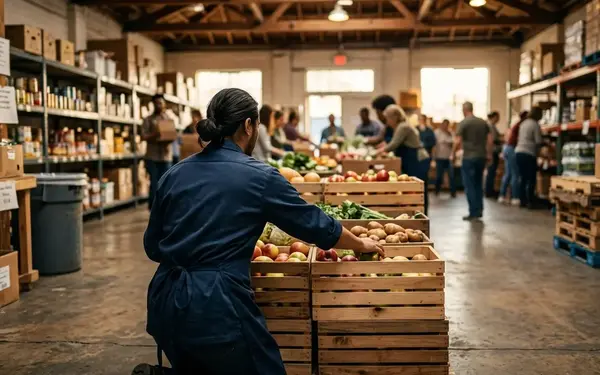
A willing donor does not complete a food rescue. Someone must reach the loading dock during a narrow pickup window, verify the food, preserve temperature, and move it to a distribution point while it remains useful.

Time-and-temperature-control foods must remain at or below 41°F. Prepared-food rescue consequently operates in hours rather than days, with many handoffs occurring during the same shift or the following morning. Refrigerated cargo vans serving routes of eight to 12 stops need pre-cooling before the first pickup. An ambient vehicle can safely carry bakery products, shelf-stable goods, and firm produce, but it cannot substitute for refrigeration when the load contains dairy, cut produce, or protein.
Geography sharpens the constraint. The regional food bank serving Buncombe covers a 16-county mountain area, so agency pickups in outlying communities may occur only once or twice per week. A grocery donation available Tuesday evening cannot wait for a Thursday route if its safe recovery window closes Wednesday morning.
Build Routes Around the Handoff
Reliable recovery starts with a precise offer: product type, quantity, holding temperature, pickup entrance, available time, and receiving capacity. Volunteer coordination follows that information. Dispatching a driver before confirming the receiving site merely transfers uncertainty from one loading dock to another.
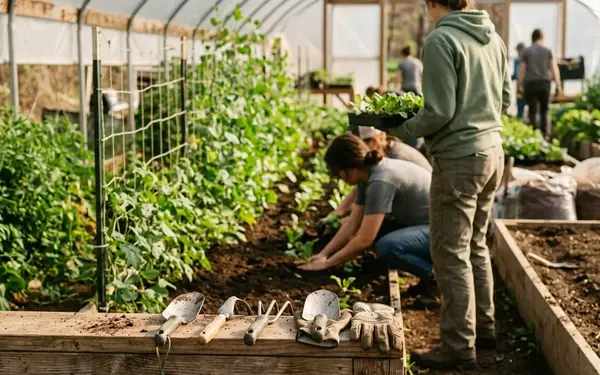
Farm gleaning uses a different clock. Mountain crews often assemble somewhere around eight to 15 volunteers within three to five days after the grower’s final commercial pick. The organizer must match field readiness, weather, labor, containers, and a recipient capable of moving fresh produce quickly.
The federal Bill Emerson Good Samaritan Food Donation Act of 1996, strengthened by recent amendments, and North Carolina’s donor-protection statute protect good-faith donors from civil and criminal liability absent gross negligence. Those protections address donor hesitation. They do not replace temperature logs, clean containers, trained handling, or a confirmed recipient. Regional food banks and grassroots rescue groups make recovery credible by applying those controls to each handoff.
Match Unavoidable Scraps to the Right Compost System
Once food can no longer feed people, composting returns part of its biological value to the soil. The central design question is who controls the feedstock and carries the contamination risk.
Municipal curbside collection can gather large volumes and make participation convenient. It also combines material from many kitchens, increasing the chance that produce stickers, utensils, and foodservice products labeled compostable will enter the load. Some compostable plastics fail to break down under field windrow conditions, even when the package language suggests otherwise.
Decentralized systems narrow that risk. Asheville-area bucket-swap subscriptions commonly provide weekly pickup of four- to five-gallon lidded containers for roughly $25 to $35 per month. Backyard bins handle produce trim and coffee grounds with little transport, though meat, dairy, and fats generally require a managed service.
Heat, Carbon, and Curing Determine the Product
Commercial composting depends on controlled biology. Windrow systems must sustain 131°F for 15 days with at least five turnings for pathogen reduction. Aerated static piles reach the equivalent temperature standard for three consecutive days. Both approaches then require curing, commonly for a month or two.
Food scraps alone create poor feedstock. Operators blend them with leaves, wood chips, spent grain, or another carbon source to approach a carbon-to-nitrogen ratio of 25:1 to 30:1. Without that structure, wet scraps lose oxygen, produce odors, and provoke neighbor opposition.
North Carolina requires a Type 3 solid-waste compost permit for commercial-scale food-waste processing. Siting buffers measured in hundreds of feet from dwellings, wells, and property boundaries exclude many parcels within Asheville’s built footprint. Zoning, suitable land, capital, and contamination controls must therefore advance together.
The resulting compost has a local use. A quarter-inch to half-inch topdress builds soil organic matter incrementally over several seasons. On Western North Carolina’s sloped clay soils, improved infiltration becomes especially visible during intense summer rain, while better moisture retention can reduce reliance on synthetic fertilizer inputs over time.
Run a Seven-Day Buncombe Kitchen Audit
A one-week audit reveals enough repetition to change purchasing without turning dinner into a month-long research project. It must include a weekend, when cooking and eating-out patterns often diverge from weekdays.
Set Up the Three-Part Log
- Place one container. Reserve a lidded, one-gallon countertop container for discarded food. Empty and record it at the end of each day rather than logging every trip to the counter.
- Use three headings. Mark each entry “spoiled before use,” “plate scrapings,” or “unavoidable trim.” Record the item and rough quantity. If a kitchen scale is available, weigh the daily amount to the nearest tenth of a pound.
- Separate action from diversion. The first two categories reveal purchasing, storage, portioning, or cooking problems. Peels, bones, and coffee grounds go directly to a backyard bin or bucket-swap service.
- Choose one correction per pattern. Change the package size, storage method, recipe quantity, or meal schedule connected to the recurring item.
- Repeat after six to eight weeks. Use the same categories and seven-day span to test whether the correction held.
A Two-Person Asheville Example
Consider a two-person household that records half a loaf of stale sandwich bread on day five, a wilted bag of spring mix on day six of an intended 10-day run, two servings of leftover rice from a Sunday batch, and about two pounds of unavoidable trim across the week.
The residents circle the first three entries. On the next shopping trip, they buy a half loaf. They move the new greens from the crisper into a lidded container with a paper towel to manage moisture. On Sunday, they cook two servings of rice instead of four. Each evening, peels, coffee grounds, and other unavoidable trim enter the subscription bucket.
Six weeks later, they repeat the audit from Monday through Sunday with the same one-gallon container and three headings. Bread, greens, and rice no longer appear in the actionable columns. They keep the smaller loaf, covered greens, and two-serving rice measure on the household shopping and cooking list, then carry the sealed trim bucket to its weekly pickup.




Responses
No comments yet.
Write a Comment