
Matching Your Food Access Issue to the Right Public Body
When a neighborhood lacks a grocery store, a school meal rule changes, or a community garden needs land, which elected board actually holds the legal authority to act?
Wait until May to bring a SNAP recertification delay or a school meal debt policy to an Asheville City Council podium, and your advocacy dies twice over. First, City Council holds zero jurisdiction over county human services staffing or school district nutrition rules. Second, the municipal budget is already drafted by late spring.
Effective food security advocacy starts with where the problem sits geographically and legally. Before drafting a petition, look up the affected address on the Buncombe County GIS parcel viewer. That single map confirms whether a site sits inside Asheville city limits, inside another incorporated town like Black Mountain, Weaverville, Woodfin, Montreat, or Biltmore Forest, or out in unincorporated Buncombe County.
In this Article
- City of Asheville: Land Use, Municipal Grants, and Transit Stops
- Buncombe County: Farmland Preservation and Nutrition Assistance Administration
- School Boards and State Government: Cafeteria Procurement and Statutory Rules
- Locating Meeting Agendas and Submitting Effective Public Requests
Four distinct decision layers govern a single household's food access:
- Municipal Councils (City of Asheville and incorporated towns): Control zoning rules, municipal land leases for community gardens, city grant cycles, and local transit stops.
- Buncombe County Board of Commissioners: Funds Health and Human Services staffing for benefit processing, backs regional farmland conservation, and distributes countywide emergency food allocations.
- Boards of Education (Asheville City Schools and Buncombe County Schools): Set district unpaid meal charge policies, sign cafeteria vendor contracts, and manage summer meal sites.
- North Carolina General Assembly and State Agencies: Establish statewide benefit eligibility thresholds, retail food safety codes, and statutory boundaries that local boards cannot override.
If a parcel lookup shows the address outside Asheville city limits, or if agency staff can cite a state statute or federal rule behind the barrier, the Asheville City Council and its municipal ordinances drop out of the conversation entirely.
City of Asheville: Land Use, Municipal Grants, and Transit Stops
Inside city limits, policy & planning barriers usually trace back to the Unified Development Ordinance (UDO), codified within the City of Asheville Code of Ordinances. When organizers want to set up a weekly mobile market in a church parking lot, open a seasonal produce stand, or build a small neighborhood grocery store, staff in Planning and Urban Design check the UDO use table. That table dictates whether the activity is permitted by right, permitted with special requirements, or requires a conditional zoning process.
Rewriting those rules takes lead time. Text amendments to the UDO to expand urban agriculture uses must pass through Planning and Zoning Commission review before reaching City Council for a vote, a sequence that takes about 2 to 4 months from staff drafting to final passage. Note that addresses in Woodfin, Weaverville, Black Mountain, Montreat, or Biltmore Forest answer to those towns' own governing boards and ordinances, so Asheville's UDO and municipal land policies never carry over across town lines.

For community initiatives seeking public growing space, the city structures community garden and edible landscape arrangements on municipal parcels as renewable license or lease agreements running roughly 1 to 5 years. Those contracts carry real operational weight: they specify who pays for water service installation and usage, and who carries liability insurance for volunteers on the lot.
Nonprofits seeking municipal dollars must watch the calendar just as closely. The City of Asheville's Strategic Partnership Grants run on an annual cycle tied to the July 1 fiscal year. Applications open and close during the winter, months before council adopts the final budget. A food program looking for FY2025–26 operational support had to submit its paperwork during the preceding winter window.
Physical access to food also depends on Asheville Rides Transit (ART). Planners and riders judge transit grocery access by two metrics: walking distance to the nearest bus stop and weekend route frequency. When an ART route runs on hourly or longer headways on Sundays, it removes weekend grocery trips as a realistic option for households carrying perishable bags home by bus.
Buncombe County: Farmland Preservation and Nutrition Assistance Administration
North Carolina runs SNAP, branded locally as Food and Nutrition Services, as a state-supervised, county-administered program. Federal and state officials set income eligibility rules, while Buncombe County Health and Human Services (HHS) handles intake, case processing, and recertifications.
Federal SNAP rules mandate a decision on a standard application within 30 days, and within 7 days for qualifying expedited applications. Whether Buncombe County HHS meets those federal clocks depends directly on county staffing decisions set by the Board of Commissioners during the annual budget process. Rather than asking commissioners to change federal benefit rules they do not control, effective local advocacy focuses on asking HHS for caseload-per-worker figures and pushing commissioners to fund open caseworker seats.
County Farmland Conservation Timelines
Protecting working soils for sustainable agriculture requires long planning horizons. Conservation easement transactions involving Buncombe County funds take around 9 to 18 months from initial application to closing, covering appraisal, survey, title work, and formal approval by the Board of Commissioners.
Beyond nutrition benefits, county policy determines whether regional farms survive development pressure. Landowners can enroll working parcels in North Carolina's Voluntary Agricultural District program under a revocable agreement, or step up to an Enhanced Voluntary Agricultural District, which requires a 10-year irrevocable commitment to farming in exchange for stronger protections and benefits.
Tax policy shapes smaller farm viability too. North Carolina present-use value taxation requires minimums of 10 acres in production for agricultural land, 5 acres for horticultural land, and 20 acres for forestland. Because many smaller Buncombe County market farms fall below that 10-acre agricultural threshold, county soil and water conservation grants and countywide community funding pools remain vital tools for supporting producers across both incorporated towns and unincorporated rural valleys.
School Boards and State Government: Cafeteria Procurement and Statutory Rules
Two separate public school systems operate within the county: Asheville City Schools and Buncombe County Schools. Even where their attendance zones sit a few streets apart, each district answers to its own elected board of education, employs its own child nutrition director, and enforces its own meal charge rules.
Since July 2017, the USDA has required every school food authority running the national school lunch program to maintain a written unpaid meal charge policy. That board-adopted policy is a public document. Advocates can pull both districts' policies right now to compare how each board handles student meal debt, alternative meals, and parent notifications.
Recent federal rule shifts have opened new doors for local school boards willing to act:
- Universal Free Meals via CEP: In 2023, the minimum identified student percentage required for a school or group of schools to offer free meals to all students under the Community Eligibility Provision dropped from 40% to 25%. That lower threshold widened the pool of local schools where boards of education can adopt universal free meals.
- Rural Summer Meal Pickups: Since 2023, federal nutrition rules have allowed non-congregate summer meal service, including grab-and-go and multi-day meal pickup, in qualifying rural areas. That flexibility is a major operational tool for Buncombe County Schools sites in outlying valleys where families cannot travel daily to a central cafeteria.
Knowing when to pivot from a local board to Raleigh saves months of wasted effort. Apply a simple test: can the local board legally vote to change this rule tomorrow? Retail food establishment regulations in North Carolina are set at the state level and enforced locally by county environmental health inspectors. Buncombe County cannot adopt its own stricter or looser food code for restaurants, shared commercial kitchens, or mobile food units. When a barrier stems from the state food code, statewide SNAP eligibility criteria, or farm-to-school state budget allocations, direct your campaign to our delegation in the North Carolina General Assembly and the relevant state departments.
Locating Meeting Agendas and Submitting Effective Public Requests
Local government advocacy runs backward from July 1. Every North Carolina city, county, and school board operates on a July 1 to June 30 fiscal year, and the law requires elected boards to adopt a balanced budget ordinance by July 1.
By the time a manager presents a proposed budget in late spring, the real trade-offs are already locked in. City of Asheville and Buncombe County budget work sessions typically run from February through May, while department heads compile their internal budget requests between December and February. That winter drafting window is the optimal moment to put a funded proposal on a department director's desk.
When tracking a specific vote, use North Carolina's open meetings law to your advantage. Public bodies must maintain a posted schedule of regular meetings online and provide at least 48 hours' notice for special meetings. Full agenda packets—including staff memos, draft ordinances, and line-item contracts—commonly appear on city, county, and school board portals 4 to 7 days before the meeting.
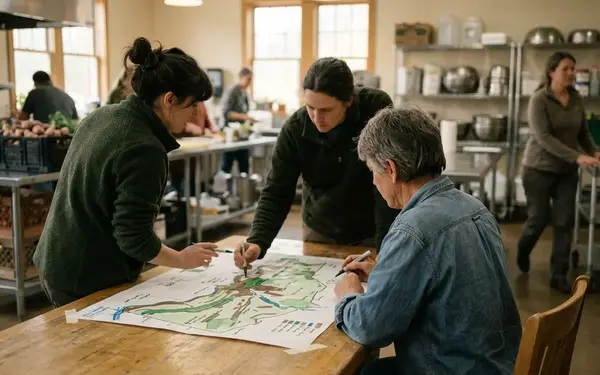
Pay attention to the venue format before you show up. Formal public comment at full council and commission meetings is typically capped at 3 minutes per speaker, requires signing up before the gavel drops, and prohibits back-and-forth dialogue with elected members. In contrast, advisory committees and staff work sessions routinely allow 10 to 20 minutes for presentations and invite direct questions from board members, making them far better spaces to walk through a spatial map or a program cost estimate.
Never wait for the formal three-minute public comment period at a full Tuesday evening council or commission meeting to introduce a food policy request. Submit a written proposal with specific budget numbers or ordinance language directly to department staff and the relevant advisory committee between December and January, before annual budget work sessions begin.






Responses
No comments yet.
Write a Comment